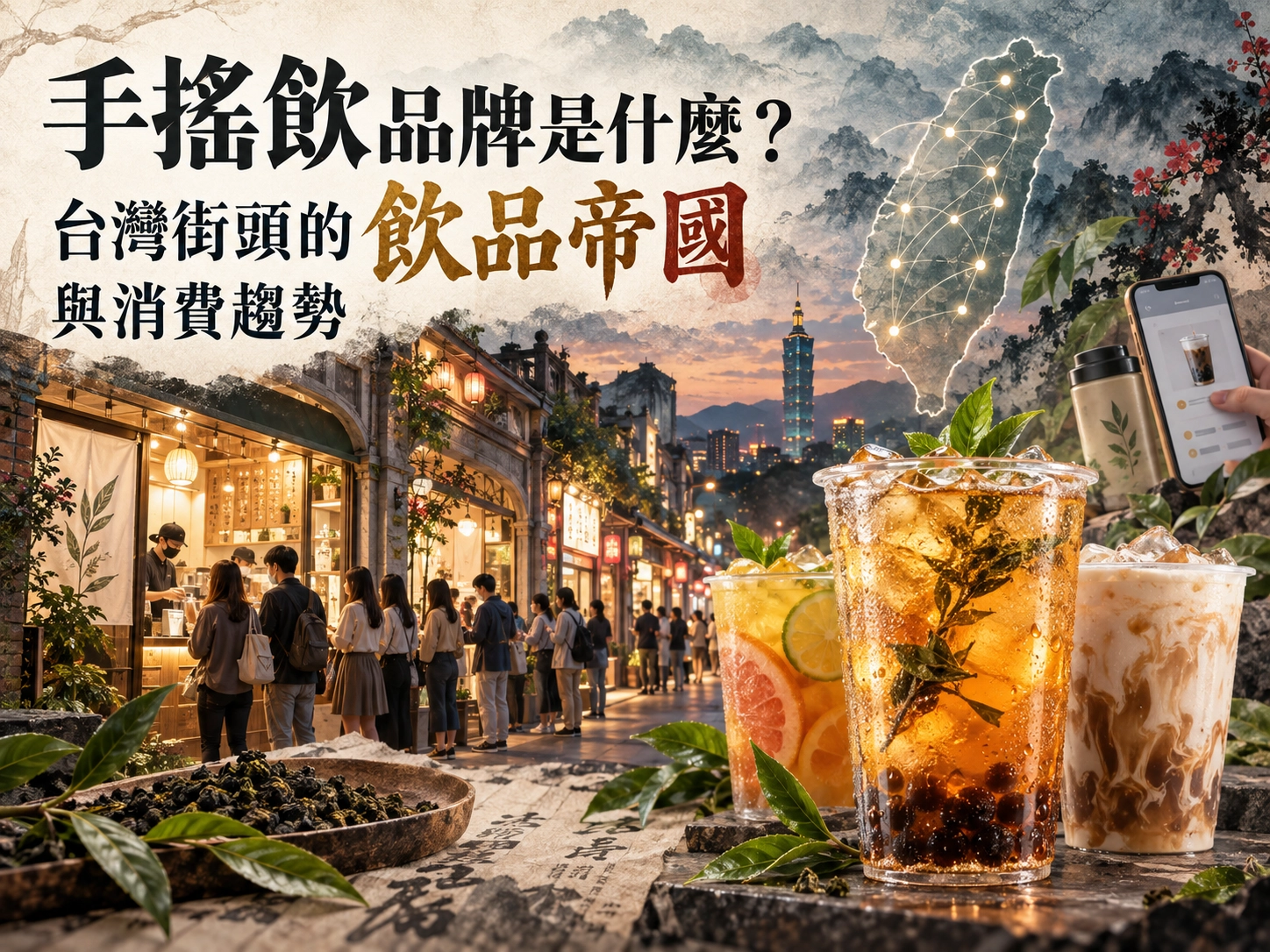
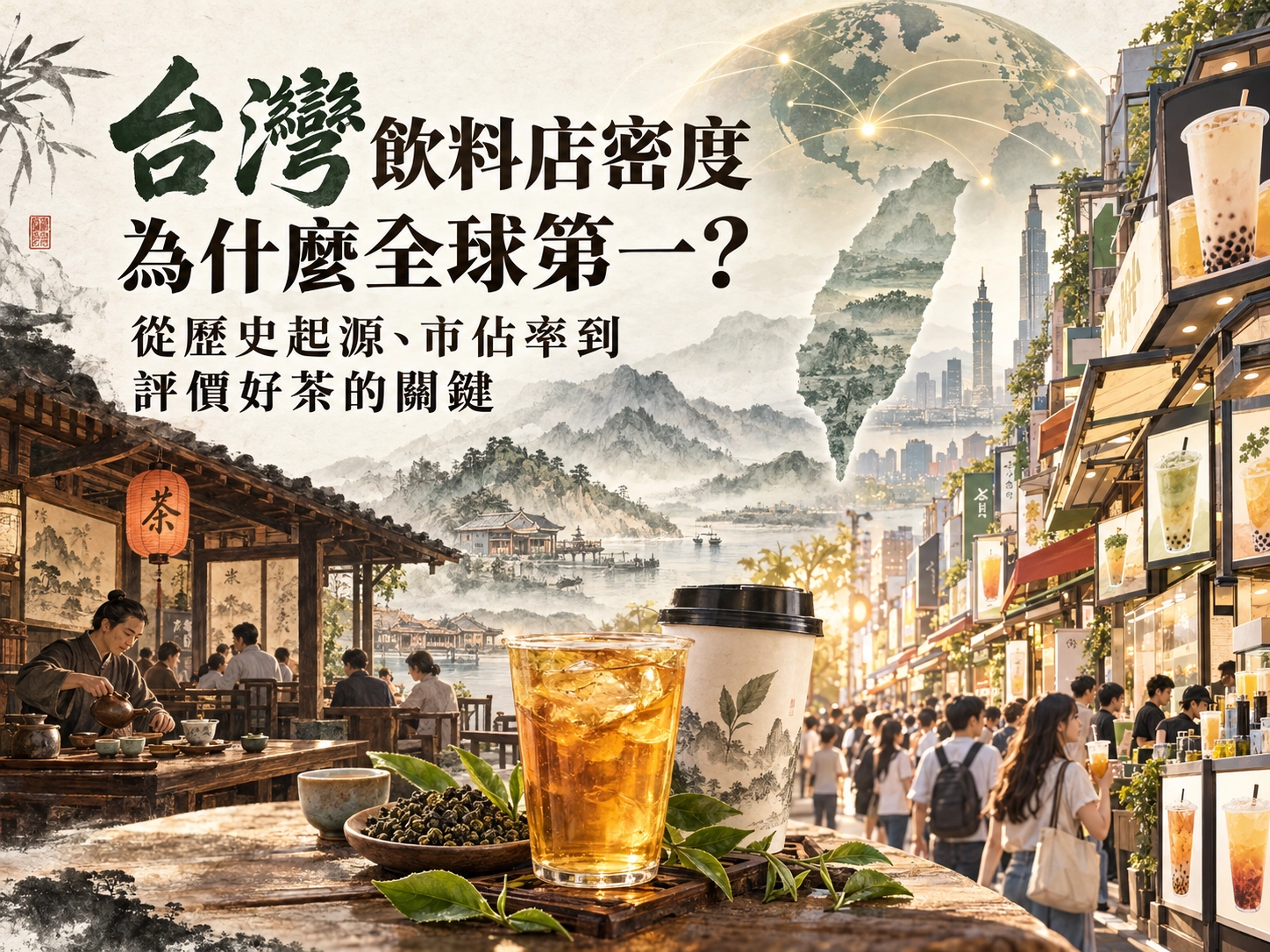
Taiwan's tea shops represent a unique local food culture and a source of national pride. From early traditional tea stalls to today's globally popular bubble tea empire, Taiwanese tea shops generate tens of billions of NT dollars in annual output and have become an indispensable part of everyday life. This article explores the development of Taiwan's tea shops, analyzing the industry today, market share trends, and how consumers judge quality—offering the most complete picture of Taiwan's tea drink market.
The Origins and History of Taiwanese Tea Shops
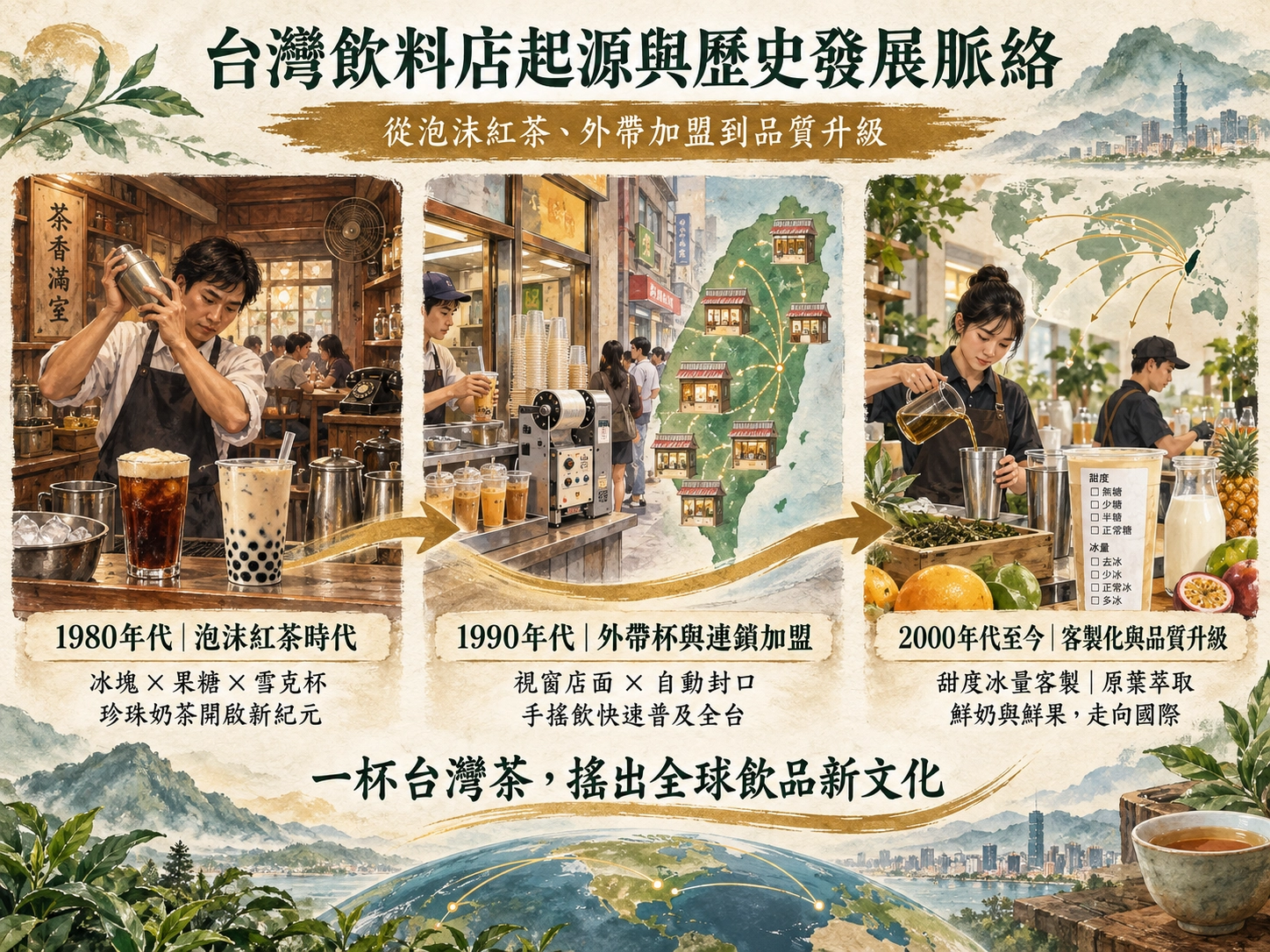
The story of Taiwan's tea shops is one of innovation and industry transformation. The prototype of Taiwanese shaken tea dates back to the early 1980s, when tea drinking was mostly limited to traditional teahouses and small pots of hot tea.
- The Foam Black Tea Era (1980s): In the early 1980s, Liu Han-chieh, founder of Chun Shui Tang in Taichung, was inspired by Japanese iced coffee and tried adding ice and fructose to hot black tea, shaking it in a cocktail shaker to create a creamy, frothy "foam black tea"—completely overturning the notion that tea must be served hot. Around 1987, teahouses added tapioca balls, a traditional Taiwanese snack, to milk tea, officially inventing bubble milk tea and launching a new era of shaken tea drinks.
- Take-Away Cups and the Franchise Wave (1990s): In the 1990s, Leisure Station (Xiu Xian Xiao Zhan) was founded, simplifying the traditional teahouse into a take-away window shop. Combined with automatic cup-sealing technology, it greatly lowered operating costs and price barriers, sparking a nationwide franchise boom for take-away bubble tea shops.
- The Era of Customization and Quality Upgrades (2000s–Present): As consumers demanded more health and quality, Taiwanese tea shops developed precise sweetness and ice customization (such as light sugar, light ice, and less ice) and moved from big batches of pre-brewed tea to whole-leaf brewing, fresh milk instead of creamer, and freshly squeezed fruit—further expanding into international markets.
To learn more about the history of Taiwan's tea industry and processing standards, see the authoritative public information from the Tea and Beverage Research Station, Ministry of Agriculture.
Taiwan's First Tea Shop and the Truth Behind the Birth of Shaken Tea
Which shop was Taiwan's "first" and where shaking techniques originated have long been among the most debated topics in Taiwanese tea culture. Strictly speaking, the development of shaken tea can be divided into two stages: cold tea drinks and shaken foam tea:
- The prototype of cold tea: Tracing back to the earliest shops selling iced black tea, Shuang Chuan Black Tea in Tainan, founded in 1949, was one of the pioneers in applying the shaken-brew concept to cold black tea.
- The birthplace of foam black tea and bubble milk tea: The key shops that brought the cocktail shaker into tea and successfully commercialized foam black tea and bubble milk tea are best known as Chun Shui Tang in Taichung and Hanlin Tea Room in Tainan. The two were locked in a years-long legal dispute over who invented bubble milk tea; the court ultimately ruled that bubble milk tea was a new type of blended drink rather than a patentable invention—establishing it as part of Taiwan's shared cultural heritage.
Distribution and Market Share of Tea Shops in Taiwan
Taiwan's tea shop density ranks among the highest in the world. According to the Department of Statistics (Ministry of Economic Affairs) and Ministry of Finance tax data, there are now more than 23,000 bubble tea shops across Taiwan, with total sales continuing to grow in a highly competitive market.
Number of Chain Stores and Market Share Rankings in Taiwan
Among chain brands in Taiwan, long-established brands—backed by large franchise networks and high brand awareness—still lead in store count:
| Tea Shop Brand | Estimated Stores in Taiwan | Core Territory | Brand Highlights |
| Ching Shin Fu Chuan | 930+ | Evenly spread nationwide; dominant in Yilan | Long-established, IP collaboration marketing |
| 50 Lan | 600+ | Strong in northern and central Taiwan and outlying islands | Consistent quality, classic pure teas |
| Tea Magic Hand | 450+ | Home base in Yunlin, Chiayi, Tainan, and Kaohsiung | King of the south, great value |
| Macu Tea | 300+ | Nationwide (strong share in the south) | Fresh-cut fruit teas, cheese foam series |
| CoCo Fresh Tea & Juice | 300+ | Nationwide, mainly northern Taiwan | International expansion, diverse products |
Regional Distribution Characteristics
- Southern Taiwan (Kaohsiung and Tainan): Kaohsiung and Tainan have the highest density of bubble tea shops in Taiwan, accounting for more than 30% of all stores. The southern market favors great value, sweeter tastes, and locally rooted brands (such as Tea Magic Hand).
- Northern and Central Taiwan: Northern consumers have strong spending power and readily embrace premium-priced brands with stylish packaging and fresh milk tea (such as Guiji, Yi Mu Ri, and Kebuke), while central Taiwan (Taichung) is a testing ground for innovative tea brands and flagship store formats.
For the latest statistics on Taiwan's food and beverage industry, visit the Department of Statistics, Ministry of Economic Affairs to browse relevant reports.
How Taiwanese Tea Shops Are Rated: Consumer Criteria and Preferences
How consumers rate Taiwanese tea shops depends heavily on their age and drinking needs. As the market matures, ratings have shifted from being purely price-driven to being driven by overall quality.
- Quality and food safety trust: Whether a brand discloses where its tea comes from, passes SGS pesticide residue tests, and follows sugar and caffeine labeling rules are the top indicators of brand trust.
- Tea depth and sweet aftertaste: Whether unsweetened pure tea is bitter and whether it leaves a sweet, refreshing finish is the cornerstone test of a shop's brewing craft and tea quality. For example, 50 Lan and Ching Shin Fu Chuan have long won praise across generations for their consistent pure tea quality.
- Toppings and signature R&D: The chewiness of tapioca pearls, the texture of innovative toppings such as fen guo and cao zai guo (as at Yi Mu Ri), and the authentic flavor of fresh fruit drinks (as at Macu Tea) are key to earning high ratings from Gen Z.
For authoritative information on bubble tea calories and food safety labeling rules, see the Taiwan Food and Drug Administration, Ministry of Health and Welfare.
Tea Shop Consumption Trends in Taiwan: Customized Experiences and Behavior in the Social Media Era
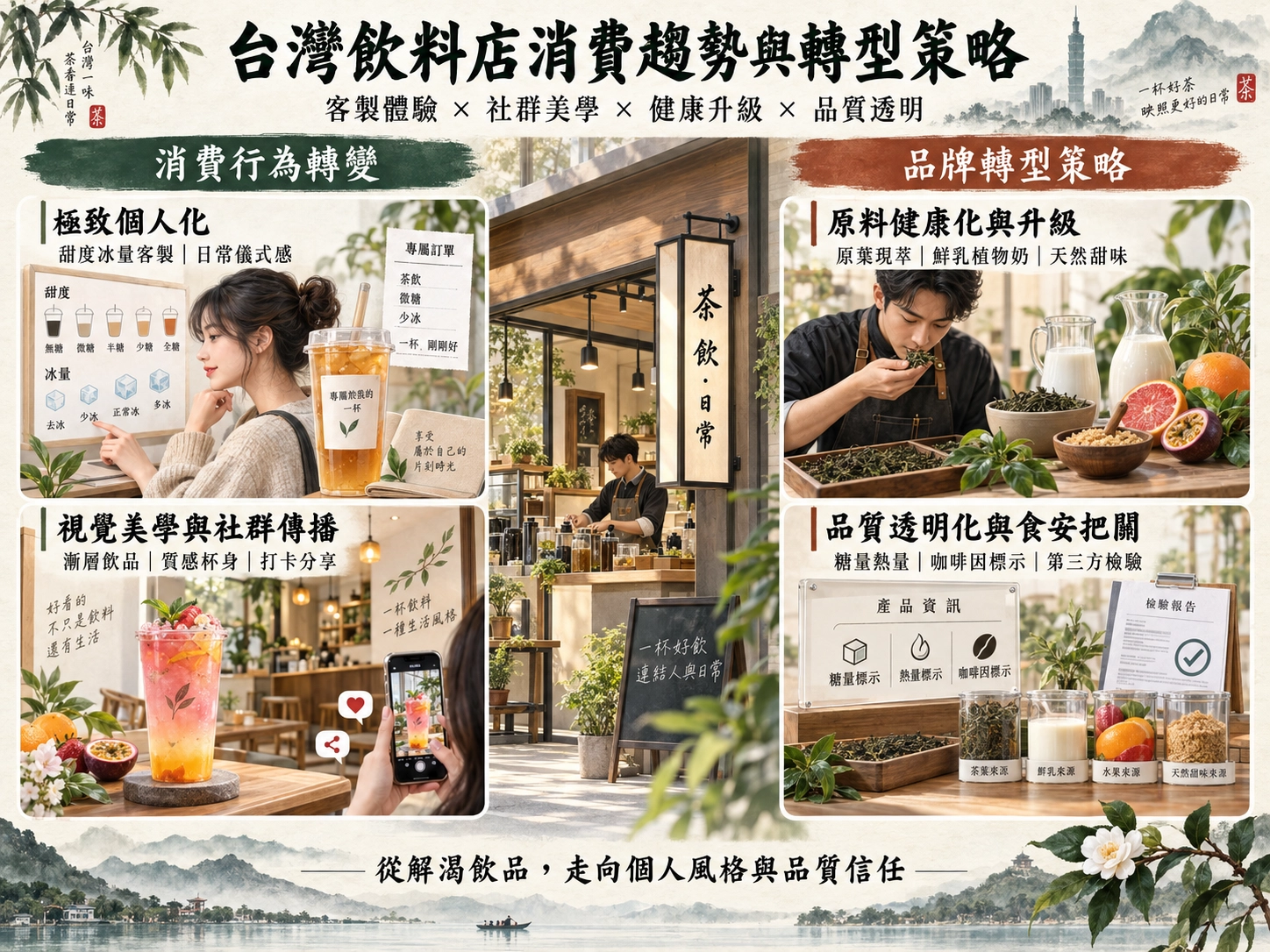
Today's consumers rely on Taiwanese tea shops for much more than quenching thirst, with two main behavioral traits:
- Highly Personalized Customization:
- Detailed drink specifications: Customers control everything from no sugar to full sugar and no ice to extra ice.
- Creating a daily ritual: Having a drink becomes a personal everyday ritual for relaxation.
- Driven by Visual Aesthetics and Social Sharing:
- Visual products: Gradient colors, stylish cup designs, and limited-time toppings spark buzz.
- Spaces and symbolic experiences: Distinctive store designs encourage check-ins and sharing, turning drinks into trendy symbols of personal taste and lifestyle.
Transformation Strategies for Taiwanese Tea Shops: Product Planning for Health-Conscious Consumers
Facing a wave of rising health awareness, Taiwanese tea shopsoperators are restructuring their products through the following strategies:
- Healthier, Upgraded Ingredients:
- Tea and sweeteners: Fully adopt freshly brewed whole-leaf tea, natural fructose, and zero-calorie sweeteners.
- Dairy alternatives: Replace traditional creamer with fresh milk from small farms and plant-based milks (such as oat milk).
- Quality Transparency and Food Safety Control:
- Compliant labeling: Proactively label total sugar, total calories, and caffeine levels.
- Third-party certification: Provide SGS ingredient test reports to build highly transparent quality control and tap into the blue ocean of premium pure tea and healthy functional drinks.
Upgrading Taiwan's Tea Shop Industry: Automation and Standardized Operations (SOP)
Facing rising labor costs and staff shortages in F&B, Taiwanese tea shopsoperators are actively using technology to optimize operations and achieve two key goals:
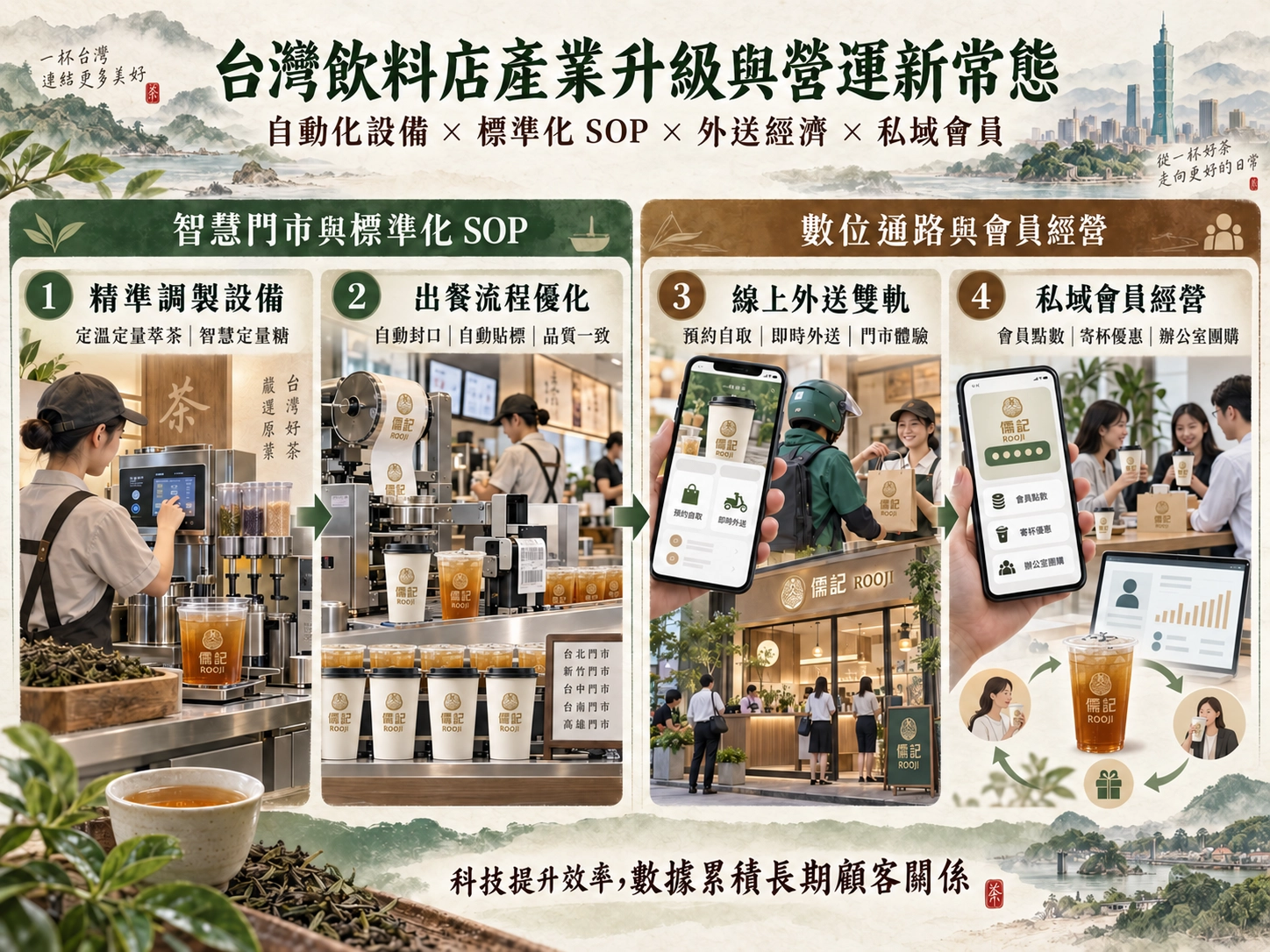
- Comprehensive Automation:
- Precise drink preparation: Introduce temperature- and volume-controlled tea brewers and smart sugar dispensers.
- Streamlined service: Install automatic cup sealers and automatic labeling systems.
- Efficiency and Consistent Quality:
- Greater service capacity: Dramatically shorten customer wait times and speed up service at peak hours.
- Eliminating human error: Precise parameter control ensures every cup tastes the same at every location, laying a solid foundation for chain expansion.
The New Normal for Taiwanese Tea Shops: Adapting to the Delivery Economy and Building Your Own Customer Base
The spread of delivery platforms and mature online ordering systems has reshaped how Taiwanese tea shops interact with customers and earn revenue:
- A Dual-Channel Strategy:
- Online pre-orders and delivery: Meet customers' habit of using mobile apps to pre-order for pickup or delivery, balancing the in-store experience with digital efficiency.
- Building a Direct-to-Consumer (DTC) Brand Community:
- Owned membership channels: Build a dedicated LINE Official Account and loyalty points system to reduce reliance on third-party delivery commissions.
- Deeper customer relationship management: Use prepaid-drink promotions and office afternoon-tea group order plans to gain precise insight into purchasing data and repeat habits, establishing a stable revenue base.
The Future of Taiwanese Tea Shops: Healthier, More Automated, and More Global
Facing a highly saturated market and rising labor costs, Taiwanese tea shops are transforming and upgrading:
- Healthy, guilt-free options: Use of unsweetened freshly brewed whole-leaf tea, plant-based milks (oat milk), and natural fructose has risen sharply.
- Adopting automated equipment: To avoid manual preparation errors, temperature- and volume-controlled tea brewers, automatic sealers, and automatic labeling equipment are now widely used to standardize quality.
- Global expansion: Taiwanese bubble tea brands have successfully entered North America, Southeast Asia, Europe, and Northeast Asia, bringing Taiwanese tea culture to the global market.
From the rise of foam black tea and the spread of take-away chains to today's pursuit of health and quality, the four-decade evolution of Taiwanese tea shops has been a continuous refinement of tea craftsmanship. ROOJI carries on this deep Taiwanese tea heritage, insisting on contract-grown high-mountain whole-leaf tea and traditional temperature-controlled roasting. In a modern era that values innovation and food safety transparency, ROOJI is reshaping the tea experience with artisan fresh brewing—turning classic tradition into cups of naturally sweet, unsweetened, trustworthy tea and leading Taiwanese shaken tea into a new era of quality.
Looking for a premium bubble tea with a truly sweet finish and no bitterness, or a stable, high-quality Taiwanese tea supply chain that passes strict food safety testing? Whether you want to experience the refined flavor of natural tea or plan a customized tea partnership, feel free to contact us, and let us create a premium tea experience and new business opportunities just for you!