Franchising a tea shop is a top choice for many entrepreneurs in Taiwan. To succeed in the highly competitive bubble tea market, the key is to accurately evaluate franchise fees and master financial planning and business regulations. Drawing on startup guidance from Taiwan's Small and Medium Enterprise and Startup Administration (Ministry of Economic Affairs) and the latest market trends, this article breaks down the tea shop franchise process, cost structure, and evaluation criteria to help you build a sustainably profitable tea shop.
Breaking Down Tea Shop Franchise Fees and Hidden Costs
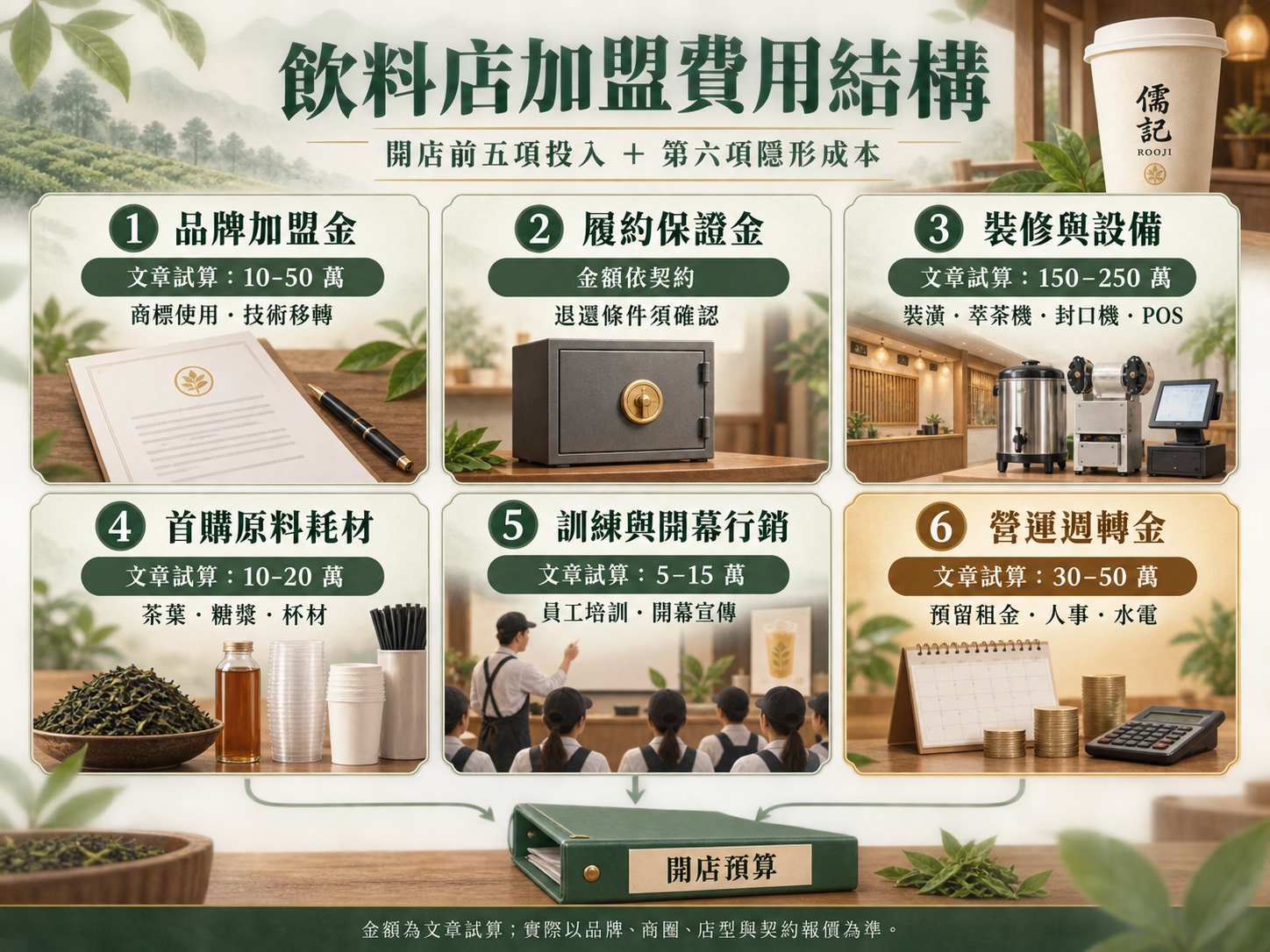
Before franchising a tea shop, entrepreneurs must understand the full structure of the total investment to avoid a cash-flow crisis. According to the franchise startup guidelines of the Small and Medium Enterprise and Startup Administration, the total capital needed for a tea shop franchise can be divided into six main items:
- Franchise Fee: A one-time fee for the right to use the brand trademark, technology transfer, and initial operating know-how. Market rates range from about NT$100,000 to NT$500,000.
- Performance Deposit: A deposit paid in advance to ensure the franchisee fulfills contract obligations (such as following ingredient purchasing rules and protecting the brand image). It is usually provided as a promissory note or cash and is fully refundable at the end of the contract if there is no breach.
- Renovation and Equipment Costs: The largest share of total investment (about 50%–60%), including store fit-out, signage, plumbing and electrical work, temperature- and volume-controlled tea brewers, automatic sealers, refrigerators, and POS systems—typically NT$1.5 million to NT$2.5 million.
- Initial Ingredients and Supplies: Tea leaves, syrups, concentrates, and packaging (cups, straws, sealing film) needed at opening—about NT$100,000 to NT$200,000.
- Training and Grand-Opening Marketing: The franchisor provides 2–4 weeks of drink-making and store management training for managers and staff, plus marketing support for the opening period—about NT$50,000 to NT$150,000.
- Working Capital:The most overlooked hidden cost. We recommend preparing at least 3–6 months of fixed expenses (rent, staff, utilities)—about NT$300,000 to NT$500,000—to get through the initial ramp-up period.
To learn more about youth startup loans and funding options, see the Youth Startup and Start-up Capital Loan section of the Small and Medium Enterprise and Startup Administration.
Tea Shop Franchise Fee Comparison and Popular Brand Types
There are many bubble tea brands on the market, and franchise fees and overall investment thresholds vary greatly by positioning. Below is a comparison of franchise costs and operating characteristics for the three main types of tea shop brands in Taiwan:
| Brand Positioning | Estimated Total Investment | Core Product Features | Best Suited For | Estimated Payback Period |
| Major Chain Brands | NT$2.5M – 4M | Very high brand awareness, complete product lines, stable customer base | Well-funded investors who prefer low risk and are willing to follow standardized processes | 18 – 24 months |
| Mid-sized premium / specialty brands | NT$1.8M – 2.8M | Signature toppings (such as fen guo jelly), fresh-fruit brews, premium packaging | Trend-focused entrepreneurs who value young consumers and social media marketing | 12 – 18 months |
| Regional / emerging micro brands | NT$1M – 1.8M | Great value, flexible franchise terms, strong local presence | Small-budget entrepreneurs who want greater operational flexibility | 9 – 12 months |
Brand Selection Strategy
- Major brands: Although franchise fees and entry thresholds are higher, they offer strong supply-chain bargaining power and brand recognition that quickly draw foot traffic from opening day.
- Emerging specialty brands: Franchise fees are more flexible, and franchisors usually offer greater territorial protection and marketing flexibility—but you need to assess whether the brand's life cycle may be too short.
How to Evaluate a Tea Shop Franchise: A Full Review Across Four Core Dimensions
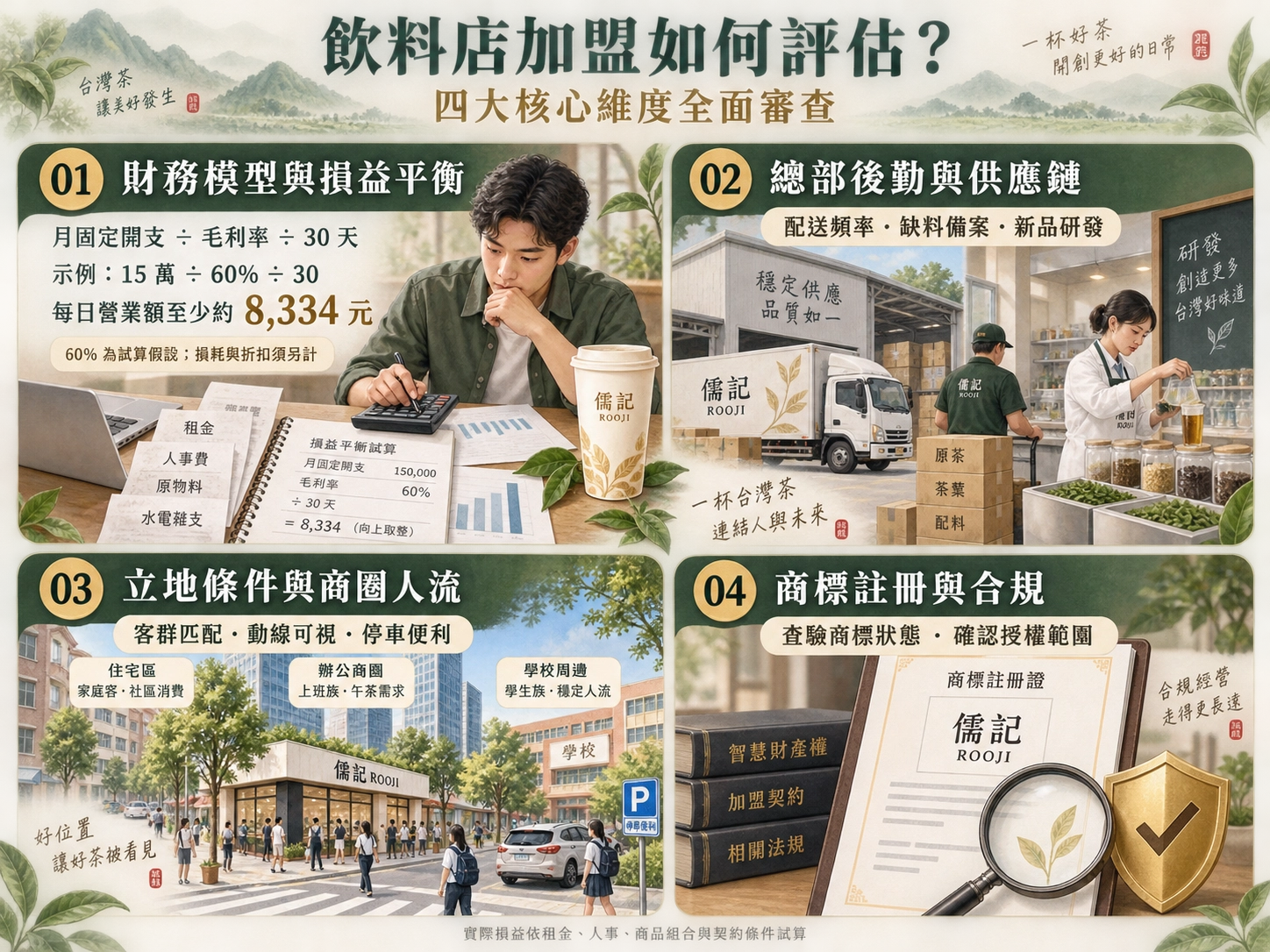
Most business failures stem from insufficient upfront evaluation. For a tea shop franchise, entrepreneurs should conduct a rigorous assessment across these four dimensions:
Financial Model and Break-Even Point (BEP) Calculation
- Gross margin: Average ingredient gross margins for bubble tea are about 60%–68%, but topping waste and promotional discounts must be deducted.
- Fixed cost deductions: Monthly revenue must first cover rent (ideally under 15% of revenue) and staff costs (ideally under 25% of revenue).
- Break-even formula:$\text{Daily break-even revenue} = \frac{\text{Monthly fixed costs}}{\text{Gross margin} \times 30\text{ days}}$. For example, with monthly fixed costs of NT$150,000 and a 60% gross margin, daily revenue must reach at least NT$8,333 to break even.
Franchisor Support and Supply Chain Stability
- Logistics: Does the franchisor have stable ingredient warehousing and delivery frequency? Are there backup plans in case of shortages?
- R&D capability: Can the franchisor launch new products every quarter to keep the brand fresh for consumers?
Location and Foot Traffic Analysis
- Customer fit: Residential areas suit families and weekend spending; office districts are driven by weekday afternoon group orders (consider the delivery share); school districts are highly price-sensitive.
- Traffic flow and visibility: Is the store on a corner with enough frontage, on the right side of traffic flow, or at a pedestrian intersection? Is parking convenient?
Trademark Registration and Regulatory Compliance
- Make sure the franchisor holds a valid registered trademark issued by the Taiwan Intellectual Property Office (Ministry of Economic Affairs) to avoid trademark infringement disputes.
To check intellectual property and trademark registration status, use the Taiwan Intellectual Property Office trademark search system for an online search.
Tea Shop Franchise Precautions and a Guide to Avoiding Contract Pitfalls
Franchise disputes are common. Under Fair Trade Commission rules, franchisors must disclose complete information before signing. When signing a tea shop franchise agreement, franchisees should pay special attention to the following:
- Review period: By regulation, the franchisor must provide a contract review period of at least 10 days. Never sign on the spot or pay a non-refundable deposit before reading the terms carefully.
- Ingredient purchasing restrictions and pricing: Does the contract require all ingredients (including packaging, tea leaves, and fresh milk) to be purchased from the franchisor? Are prices higher than reasonable market rates? Is there an annual price-adjustment mechanism?
- Territorial Protection clause: The contract must clearly state the radius (e.g., 1 km or 1.5 km) within which the franchisor may not open another company-owned or franchised store, protecting each store's revenue.
- Non-compete and termination clauses: Pay attention to the non-compete period after termination (usually 1–2 years) and its geographic scope, and make sure early-termination penalties are calculated reasonably to avoid unfair terms.
For franchise contract regulations and Fair Trade Act guidelines, see the Fair Trade Commission franchise disclosure section.
Operational Transformation and Profit Strategies for Modern Tea Shop Franchises
With the bubble tea market highly saturated, selling tea in a traditional storefront alone can no longer sustain high profits. Successful tea shop franchisees need to master three key transformation strategies:
Digital Operations and Building Your Own Customer Base
- Member traffic system: Offer online ordering for pickup and loyalty points through ONEWAY or a LINE Official Account, turning walk-in customers into long-term repeat members and reducing reliance on costly third-party delivery commissions.
- Data-driven prep: Use POS data to analyze best-selling items by time of day, precisely controlling tea brewing and topping prep to keep waste below 3%.
Managing Delivery Share and Margin Structure
- Delivery platforms charge commissions of 30%–35%. Franchisees should design high-margin combo sets for delivery (such as a drink plus a premium topping) and offer exclusive discounts for in-store pickup to steer customers toward pickup.
Automation to Cut Costs and Boost Efficiency
- Prioritize franchise brands that use temperature- and volume-controlled tea brewers, automatic sealers, and smart sugar dispensers. Standardized equipment reduces reliance on skilled workers, dramatically shortens training for new staff, and helps you overcome labor shortages.
Tea Shop Franchising Explained: From Business Risks and Changing Consumer Habits to Smart, More Profitable Operations
Spot Contract Traps and Hidden Operating Risks to Avoid Thin Margins
When evaluating a tea shop franchise, many entrepreneurs are drawn to impressive single-store revenue but overlook the financial and operational risks behind it:
- Overstated gross margins: Franchisors often fail to accurately deduct topping waste, marketing discounts, and promotional costs.
- Lack of territorial protection: Without strict clauses, the same brand can become overly concentrated in one trade area, with stores competing for the same customers.
- Squeezed by ingredient markups: If the franchisor forces franchisees to buy tea leaves, packaging, or fresh milk at above-market prices, single-store net profit will be severely squeezed.
- Key to avoiding pitfalls: Entrepreneurs must carefully calculate true costs, including working capital, and thoroughly review non-compete, breach, and termination clauses.
Customization and Quality Transparency for a Customer Experience That Drives Repeat Purchases
Today's consumers no longer choose bubble tea simply as a cheap thirst-quencher—they now care about quality, health, and a premium experience:
- Tea quality test: Whether unsweetened tea tastes bitter and whether it leaves a sweet, refreshing aftertaste has become a key measure of a brand's tea quality and brewing technique.
- Greater food safety transparency: Consumers are highly sensitive to ingredient origins. Disclosing tea origins and passing SGS pesticide residue tests directly determines trust.
- Compliant labeling: Clearly disclosing sugar and caffeine content is essential for securing a loyal customer base in a highly competitive tea market.
How Operators Can Respond to the New Normal of Health-Conscious, Freshly Brewed Whole-Leaf Tea
As health awareness rises sharply, franchise brand choices must keep pace with product upgrades:
- Product restructuring: The old model of high sugar, artificial creamer, and concentrated fructose is quickly being phased out.
- Upgraded mainstream ingredients: Freshly brewed high-mountain whole-leaf tea, natural zero-calorie sweeteners, and fresh milk from small farms and plant-based milks are now widely used.
- Key to product development: Operators who join traditional brands lacking R&D will face an aging customer base. Choosing a tea system that balances healthy, light options with great taste opens up a blue ocean of higher-value customers.
Adopting Automation and Standardized SOPs to Overcome Labor Shortages
Facing both rising labor costs and staff shortages in F&B, store operations are undergoing a major technological transformation:
- Reducing reliance on skills: Traditional training that depends on individual tea makers' experience takes a long time and easily leads to inconsistent flavor due to human error.
- Adopting automated equipment: Actively introduce temperature- and volume-controlled tea brewers, automatic sealers, and smart sugar dispensers to modularize standard pressure and extraction parameters.
- Double operational benefit: Training for new staff is cut to just a few days, improving service speed at peak hours while ensuring highly consistent quality across all locations.
Leverage Your Own Customer Base and Membership Systems to Reduce Reliance on Delivery Platforms
Delivery platforms expand a store's reach, but commissions of 30%–35% seriously erode single-store net profit:
- Build your own customer base (CRM): Savvy operators no longer blindly depend on third-party platforms; instead, they manage customer relationships through their own channels.
- Using digital tools: Offer exclusive online ordering for pickup, prepaid-drink deals, and loyalty points through ONEWAY or a LINE Official Account.
- Long-term profitability: Turn one-time passers-by into loyal, long-term brand members, gain precise insight into purchasing data and repeat habits, and maintain a healthy margin structure.

Why Franchise with ROOJI? A Century-Old Tea Garden Heritage for a Highly Profitable, Sustainable Tea Business
Among the many bubble tea brands, franchising with ROOJI (Rooj-ITEA) gives you the strongest foundation for your tea business. ROOJI carries on the deep heritage of local Taiwanese tea culture, rooted in century-old tea gardens in Nantou, with our own contracted high-mountain tea regions and proprietary temperature-controlled roasting—ensuring exceptionally stable tea quality and a price advantage right from the source. We insist on SGS-tested high-mountain whole-leaf tea, healthy toppings free of caramel coloring and preservatives, and fresh milk from small farms—perfectly meeting modern consumers' demand for both health and great taste.
As a ROOJI franchisee, you will receive the industry's most comprehensive support system:
- Transparent, sound capital and site evaluation: Dedicated site evaluation and overall financial planning with no hidden fees, helping you precisely manage startup risk.
- Data-driven automated equipment and modular SOPs: Temperature- and volume-controlled brewing technology simplifies store operations, easily overcoming labor shortages and inconsistent quality.
- Strong, stable supply chain support: With extensive experience supplying franchise systems, we provide a flexible, high-quality, and fairly priced ingredient logistics system that protects your store's healthy margins.
Ready to Start Your Tea Business? ROOJI sincerely invites passionate entrepreneurs who are committed to quality to join us. Reach out today through the ROOJI website inquiry form or call our franchise hotline to talk with our team of expert consultants—and let ROOJI help you turn the artistry of traditional tea into a stable, profitable, and sustainable business!
Looking for a premium bubble tea with a truly sweet finish and no bitterness, or a stable, high-quality Taiwanese tea supply chain that passes strict food safety testing? Whether you want to experience the refined flavor of natural tea or plan a customized tea partnership, feel free to contact us, and let us create a premium tea experience and new business opportunities just for you!